
Why Do Nonprofits Not Pay Well? The Real Reasons Behind Low Salaries in Charity Work
 Feb, 8 2026
Nonprofit Staff Budget Calculator
Calculate how much of your nonprofit's budget can be allocated to staff salaries after accounting for donor restrictions. See if fair compensation is possible given your funding constraints.
Budget Analysis
Available for Staff:
Per Staff Member:
Shortfall (if any):
Donor Impact:
Turnover Risk:
Recommendation:
Ever wonder why someone working 60 hours a week to feed the hungry, shelter the homeless, or protect the environment makes less than a barista in a coffee shop? It’s not because they’re unskilled. It’s not because they don’t care. It’s because the system itself is built to keep salaries low - and most people don’t realize how deeply that’s wired into how charities operate.
Money Goes to the Mission, Not the People
Nonprofits live by one rule: every dollar should serve the cause. That sounds noble. But in practice, it means staff pay gets treated like an expense to minimize, not an investment to honor. Board members, donors, and even volunteers often believe that higher salaries mean less impact. They think if a program director earns $70,000, that’s $70,000 taken from children’s meals. But here’s the truth: underpaying staff doesn’t stretch your budget - it breaks it.
When you pay too little, you lose good people. They burn out. They leave for hospitals, local governments, or corporate CSR roles that offer better pay and benefits. Then you spend six months and $20,000 hiring and training someone new. That’s not saving money - it’s wasting it.
The Myth of the “Passionate Volunteer”
Nonprofits love to say, “We need people who care more than money.” That phrase sounds inspiring - until you realize it’s a cover-up. It’s used to justify paying $35,000 for a full-time grant writer who could make $80,000 at a tech company. It tells people their passion should be enough to compensate for no health insurance, no retirement plan, or no paid sick days.
This myth ignores reality. You can’t run a $5 million annual program with unpaid labor. Fundraising, compliance, accounting, outreach, and program delivery require real expertise. A single grant application can take 80 hours to write. A compliance audit costs thousands. You can’t ask someone to do that for $15 an hour and expect them to stay.
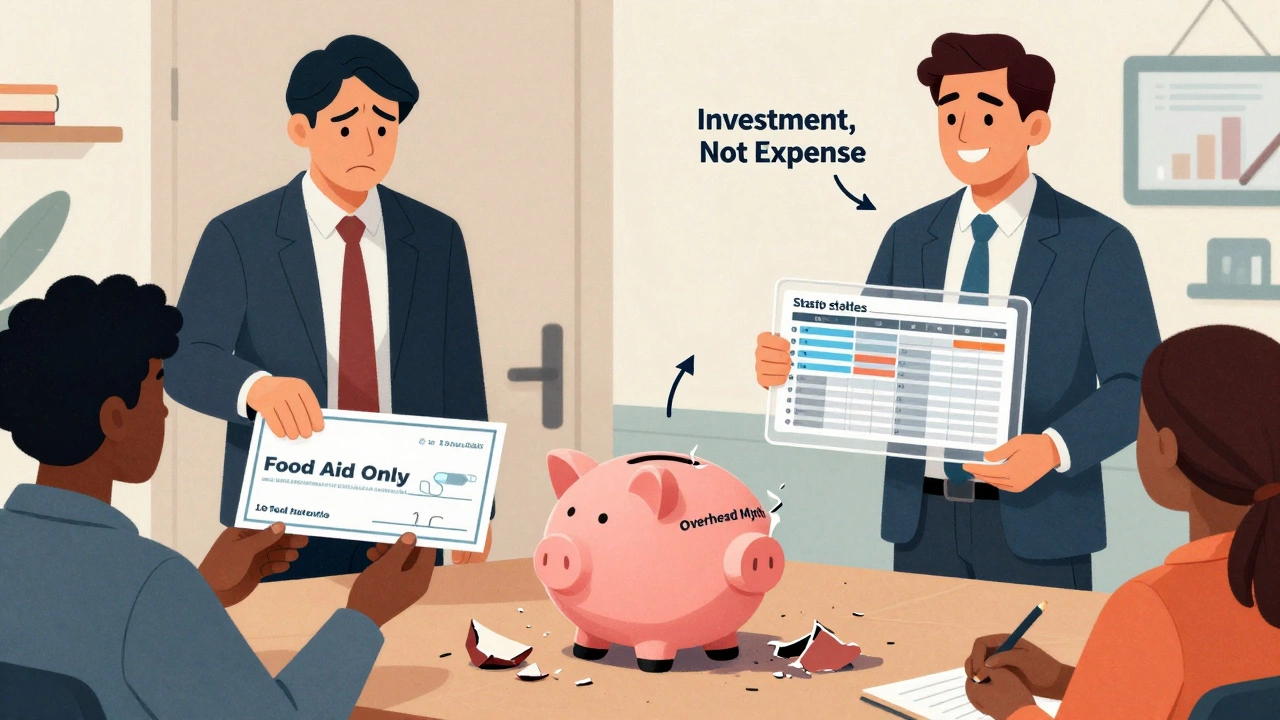
Donor Pressure and the “Overhead Myth”
Most donors check two numbers: how much goes to “programs” and how much to “administration.” They’re told administration = waste. So charities hide salaries. They pad budgets with consultants. They make staff wear three hats. A finance director might also handle HR and payroll. A program manager writes reports, trains volunteers, and answers donor emails.
It’s called the overhead myth. But research from GuideStar and the Nonprofit Finance Fund shows that nonprofits with higher administrative spending (up to 25%) actually deliver better results. Why? Because they can hire skilled people who do their jobs well - and stay doing them.
When donors demand 90% of funds go to programs, they’re not helping. They’re forcing charities into a trap: underpay staff, overwork them, and watch turnover rise. That’s not efficiency. That’s instability.

Size Matters - But Not in the Way You Think
Bigger nonprofits like the Red Cross or United Way can pay better. They have endowments, corporate partnerships, and global funding. But 85% of charities in the UK are small - under £500,000 in annual income. They rely on grants, local donations, and community events. Their budgets are tight. Their staff are often one-person teams.
For these small charities, salary isn’t a choice. It’s a calculation. If you have £400,000 a year, and £280,000 goes to food aid, you have £120,000 left. Rent is £40,000. Utilities, software, insurance - another £30,000. That leaves £50,000 for one full-time person. That’s not a salary. That’s survival mode.
The Gender and Racial Pay Gap in Charity
Nonprofits aren’t just underpaying - they’re underpaying women and people of color at higher rates. According to the Charities Aid Foundation, women make up 73% of the nonprofit workforce in the UK, but hold only 38% of leadership roles. When they do reach senior positions, they earn 17% less than men in similar roles.
Why? Because leadership roles are often filled through networks - and those networks are still dominated by white, middle-class men. Entry-level jobs are filled by young people who can afford to work for low pay. That’s not diversity. That’s exclusion.
Many nonprofits say they want equity. But if you’re paying your frontline workers £12 an hour and your CEO £65,000, you’re not building equity - you’re reinforcing inequality.
What’s Changing? A Few Bright Spots
Some nonprofits are breaking the cycle. The Scottish charity Food Train increased staff pay by 30% in 2023 - funded by reallocating donor-designated funds and cutting consultant costs. Turnover dropped by 60%. Productivity rose. Donors didn’t leave. They gave more.
Another example: Edinburgh Community Food started a “Fair Pay Pledge” in 2024. They commit to paying at least £12.50/hour (above the UK living wage) and offer full benefits. They lost one donor who said, “That’s too much on salaries.” But they gained 12 new donors who said, “Finally, someone who treats their team like people.”
These aren’t outliers. They’re proof that paying well doesn’t hurt the mission - it strengthens it.
What Can You Do?
If you’re a donor: Stop judging charities by their overhead ratio. Ask: “What’s their staff retention rate?” “Do they offer health insurance?” “How much do their program managers earn?” If they can’t answer, they’re hiding something.
If you’re a nonprofit leader: Stop apologizing for paying staff. Build a transparent budget. Show donors how staff salaries lead to better outcomes. Share data: “Our grant writer stayed 4 years - she secured £1.2 million in funding. Replacing her would cost £35,000 in recruitment and lost grants.”
If you’re considering a nonprofit job: Don’t assume low pay means low value. But do ask hard questions. What’s the turnover rate? Do they offer pension contributions? Can you work remotely? Is there a clear path to promotion? If the answer is “no” to all of them, walk away.
The idea that charity work should be unpaid or underpaid is outdated. It’s not noble. It’s unsustainable. The people doing the hardest work in our communities deserve to be paid like professionals - not saints.
Why don’t nonprofits just raise more money to pay staff better?
Many nonprofits do raise more money - but donors often restrict how it’s used. Over 60% of charitable donations in the UK are designated for specific programs, not overhead. That means even if a charity brings in extra funds, they can’t legally redirect them to salaries without breaking donor agreements. Some organizations are now asking donors to give unrestricted funds - but that’s still rare.
Are nonprofit salaries really that low compared to for-profit jobs?
Yes - and the gap is growing. According to the UK Charities Commission, the median salary for a nonprofit program manager is £36,000. In the private sector, a similar role in marketing or operations pays £52,000 on average. For executive directors, the difference is even wider: £58,000 in nonprofits vs. £95,000 in business. The gap is widest in small charities and in roles like social work, education, and housing.
Do nonprofit employees ever get bonuses or raises?
Rarely. Most nonprofits don’t have formal bonus structures. Raises are often tied to inflation or budget reviews - not performance. In many small charities, staff haven’t had a raise in 5-7 years. Some rely on one-time grants for salary increases, but those are unpredictable. The lack of regular pay growth is one reason why experienced staff leave for more stable sectors.
Can nonprofits afford to pay more without losing funding?
Yes - if donors understand the long-term value. A 2024 study by the Institute for Voluntary Action Research found that charities which paid staff fairly had 40% higher donor retention rates. People don’t leave because a charity pays its staff well. They leave because it’s chaotic, overworked, and unstable. Fair pay creates trust - and trust brings more donations.
Is this problem the same in other countries?
It’s worse in some places, better in others. In the US, nonprofit salaries are generally higher than in the UK, but so is the cost of living. In Canada and Australia, there are stronger union protections and public funding for social services, which helps. In developing countries, many nonprofit workers are volunteers or paid in-kind. But the core issue is global: the belief that compassion should be cheap.