
Should I Create a Charitable Trust? A Practical Guide for Donors
 Nov, 23 2026
Charitable Trust Viability Calculator
Use this tool to determine if the complexity of a Charitable Trust outweighs the benefits compared to simpler options like Donor-Advised Funds or direct gifting.
Recommendation
Why this recommendation?
Alternative Considerations
You have assets you want to give away. Maybe it’s a block of stock that has skyrocketed in value since you bought it. Maybe it’s real estate you no longer use but can’t bear to sell because the capital gains tax would eat up nearly a third of your profit. Or maybe you just want to ensure your legacy helps a cause you care about, without handing over a lump sum today and wondering if it was used wisely.
This is where the charitable trust enters the conversation. It sounds formal, legalistic, and expensive-like something only billionaires with yachts need. But the reality is different. For many middle-to-upper-middle-class families, a charitable trust is a powerful tool that solves three problems at once: it reduces your tax bill, provides income for you or your family, and guarantees your money goes exactly where you want it.
But should *you* create one? That depends on your numbers, your patience, and your goals. Let’s break down the mechanics, the costs, and the red flags so you can decide if this vehicle fits your life.
The Two Main Flavors: Remainder vs. Lead
Before you call an attorney, you need to know which type of charitable trust actually matches your intent. There are two primary structures, and they work in opposite directions regarding who gets paid first.
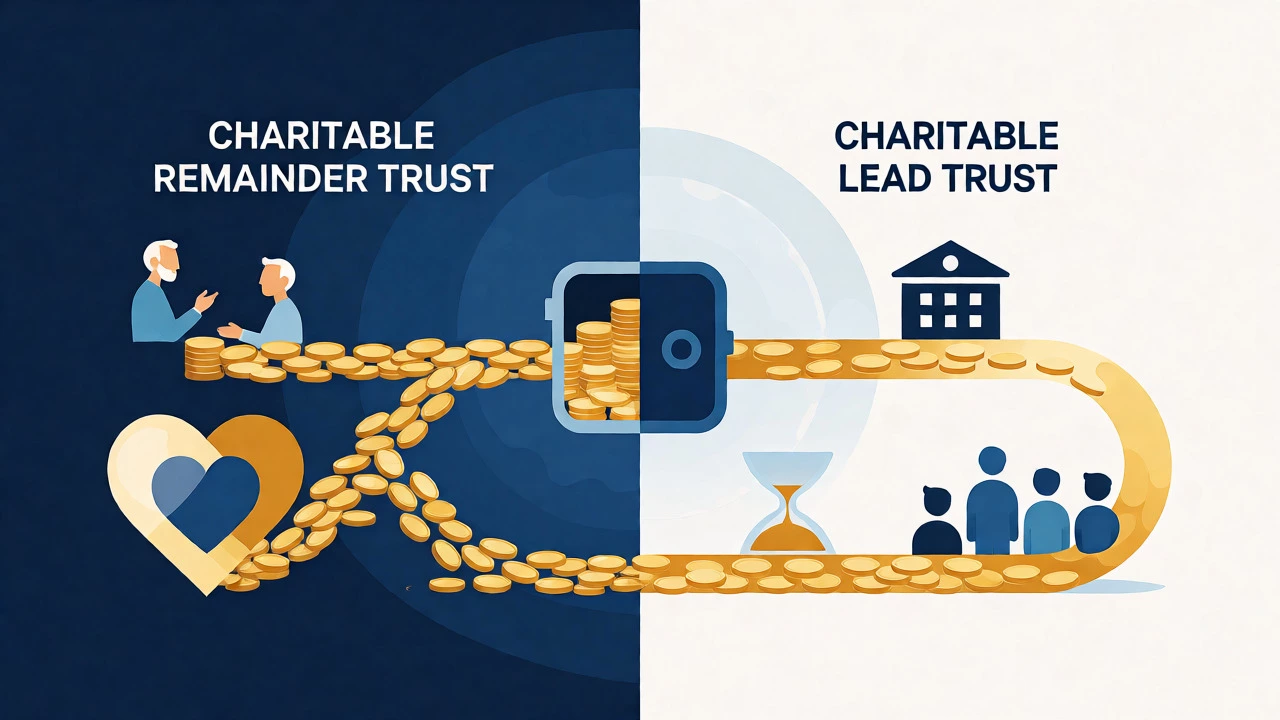
Charitable Remainder Trusts (CRTs) are designed for donors who want income now and charity later. You transfer assets into the trust. The trust pays you (or someone else) a fixed amount or percentage of the trust’s value for a set number of years or for your lifetime. When the term ends, whatever is left-the "remainder"-goes to the charity. This is the most common type for individuals looking to diversify appreciated assets while keeping cash flow.
Charitable Lead Trusts (CLTs) flip the script. Here, the charity gets paid first. They receive an annual payment for a specific period. After that period ends, the remaining assets revert to you or your heirs. This is often used by wealthy families wanting to reduce estate taxes on large wealth transfers to children, effectively letting the government subsidize part of the inheritance through tax deductions.
If you’re thinking, "I just want to donate my house," you might be leaning toward a CRT. If you’re thinking, "I want my kids to get my business tax-free eventually, but let the Red Cross help out for ten years first," you’re looking at a CLT.
The Tax Math: Why Do People Bother?
Let’s be honest: setting up a trust isn’t free. You pay legal fees, trustee fees, and administrative costs. So why do people do it? Because the tax code offers sweeteners that can outweigh those costs, provided you meet certain thresholds.
When you fund a Charitable Remainder Trust with appreciated assets like stocks or real estate, you avoid paying capital gains tax immediately. In a normal sale, if you sold $1 million of stock bought for $100k, you’d owe federal capital gains tax plus potentially state taxes and Net Investment Income Tax. Inside a CRT, the trust is tax-exempt. It sells the asset, reinvests the full $1 million (not the after-tax amount), and generates income based on the larger principal.
Plus, you get an immediate income tax deduction. This deduction is limited to a percentage of your Adjusted Gross Income (AGI)-usually 30% for appreciated property-but any excess can carry forward for five years. The exact deduction amount depends on the IRS Applicable Federal Rate (AFR) published monthly. Lower interest rates generally mean higher charitable deductions because the present value of the future gift to charity is considered higher.
| Feature | Direct Sale | Charitable Remainder Trust (CRT) |
|---|---|---|
| Capital Gains Tax | Paid immediately upon sale. | Deferred; avoided within the trust structure. |
| Investment Principal | Reduced by tax liability. | Full pre-tax value available for investment. |
| Income Stream | None (unless you buy an annuity). | Fixed payout to donor for life or term. |
| Charitable Deduction | None. | Partial deduction based on actuarial tables. |
| Control | Total control until sale. | Trustee manages assets; donor loses direct control. |
The Cost Barrier: When Does It Stop Making Sense?
Here is the hard truth: small gifts don’t justify the overhead. If you are donating $5,000 worth of Apple stock, a charitable trust is overkill. You’ll spend more on legal setup and annual accounting than you save in taxes.
Most financial planners suggest a charitable trust becomes viable when the contribution exceeds $50,000 to $100,000. At this level, the complexity of managing the trust, filing annual tax returns (Form 990-PF or 1041), and paying professional trustees starts to yield a net positive return compared to simple gifting.
Consider these ongoing costs:
- Setup Fees: Expect $2,500 to $7,500 for drafting the trust document, depending on your location and the attorney’s expertise.
- Trustee Fees: If you hire a corporate trustee (like a bank or trust company), they typically charge 0.5% to 1.5% of assets under management annually.
- Accounting: The trust must file its own tax return. Budget $500 to $1,500 per year for CPA services.
If your portfolio is too small, these fees erode the benefit. However, some community foundations offer "donor-advised funds" as a cheaper alternative, though they lack the income stream features of a CRT.
Liquidity and Lifestyle Changes
A charitable trust locks up your money. Once you transfer assets into a CRT, you cannot easily pull them back out for emergencies. The trust pays you a set income, but if you suddenly need $200,000 for a medical emergency or a home renovation, you can’t just liquidate the trust’s core holdings without penalty or complexity.
This creates a liquidity trap. Ask yourself: Do I have enough liquid cash outside this trust to handle life’s surprises? If your net worth is tied up in illiquid assets like real estate or closely held business interests, moving everything into a trust might leave you cash-poor despite being asset-rich.
Furthermore, consider your age. The younger you are, the smaller your current income tax deduction will be relative to the total gift, because the IRS assumes you will live a long time and take lots of payments before the charity gets anything. Conversely, older donors get larger upfront deductions because the charity receives the remainder sooner. If you are under 55, a charitable trust might not maximize your tax efficiency compared to other strategies like bunching donations into a single year.
Complexity and Control Issues
When you create a trust, you are creating a separate legal entity. You are no longer the owner of those assets; the trust is. This means you lose direct control over how those assets are invested day-to-day. While you can often name yourself as trustee, you are bound by fiduciary duties to both yourself (the beneficiary) and the charity (the remainderman). You can’t make risky bets hoping for a moonshot if it jeopardizes the charity’s eventual payout.
Also, changing your mind is hard. You can change the designated charity in many trusts, but you can’t simply cancel the trust and take all the money back without significant tax consequences and potential penalties. It is a commitment. If you think there’s even a slight chance you might regret giving away that vacation home in ten years, keep it.

Who Should Definitely Say Yes?
Despite the hurdles, certain profiles find charitable trusts incredibly effective. You are a strong candidate if:
- You hold highly appreciated assets: Stocks, bonds, or real estate that have grown significantly. The ability to sell tax-free inside the trust is the biggest driver.
- You want a supplemental income stream: Perhaps you are retiring soon and want to turn a low-yield asset (like a rental property generating 2% yield) into a higher-yielding diversified portfolio that pays you 5-6% annually via the trust.
- You have a clear charitable mission: You aren’t just looking for tax breaks; you genuinely want to support specific organizations and want assurance that the funds remain restricted to that purpose.
- You have a large estate: If you are concerned about estate taxes, a Charitable Lead Trust can help move wealth to heirs more efficiently.
Who Should Probably Say No?
On the flip side, skip the charitable trust if:
- Your donation is under $50,000: The administrative burden outweighs the tax savings.
- You need flexibility: If you anticipate needing access to the principal amount in the next 5-10 years, lock-up periods are dangerous.
- You prefer simplicity: If writing checks to charities feels right and you don’t care about the income stream, just donate directly. You still get a tax deduction (up to 60% of AGI for cash, 30% for appreciated assets) without the legal overhead.
- You haven’t maxed out simpler options: Consider Donor-Advised Funds (DAFs) first. They cost less to set up, require lower minimum contributions ($5,000-$25,000), and allow you to grant money to charities whenever you choose. DAFs lack the income stream feature, but they are far easier to manage.
Final Checklist Before Signing
If you’ve weighed the pros and cons and still feel a charitable trust aligns with your goals, run through this final checklist:
- Run the numbers twice: Have a CPA model the scenario with and without the trust. Ensure the tax savings exceed the combined setup and maintenance fees over the expected life of the trust.
- Check the charity’s status: Ensure the organization you plan to name is a qualified 501(c)(3) public charity or private foundation. Not all nonprofits qualify for the best tax treatments.
- Understand the payout rules: Know whether you are choosing a Charitable Remainder Annuity Trust (CRAT) which pays a fixed dollar amount, or a Charitable Remainder Unitrust (CRUT) which pays a percentage of the trust’s value (protecting against inflation but fluctuating with market performance).
- Consult independent counsel: Do not rely solely on the financial advisor selling you the product. Get a second opinion from an estate planning attorney who does not earn commissions on trust products.
A charitable trust is a precision instrument. Used correctly, it amplifies your generosity and keeps more money in your pocket. Used incorrectly, it becomes an expensive paperweight that complicates your finances. Look at your balance sheet, look at your goals, and decide if the complexity is worth the payoff.
Can I change the charity named in my trust?
Yes, in most cases. Most charitable trust documents include a clause allowing the donor or trustee to substitute another qualified 501(c)(3) organization if the original charity dissolves, merges, or loses its tax-exempt status. Some trusts also allow discretionary changes if specified in the governing document, but this requires careful drafting to maintain tax compliance.
What happens if I die before the trust term ends?
If you are the sole beneficiary of a Charitable Remainder Trust and you pass away, the trust continues to operate according to its terms. Typically, the income payments continue to your spouse or other named beneficiaries for their lifetimes, or for the remainder of the fixed term. Upon the death of all income beneficiaries, the remaining assets are distributed to the designated charity. Your estate may receive additional tax deductions related to the charitable remainder interest.
Are charitable trust payouts taxable?
Yes. The income you receive from a charitable trust is taxable. The IRS uses a four-tier system to determine the character of the distributions: ordinary income, capital gains, tax-exempt income, and corpus (return of basis). Generally, you pay taxes on the income as it is distributed, not when it is earned inside the trust. This allows for tax deferral, but the rate you pay depends on the underlying source of the earnings.
How does a charitable trust differ from a donor-advised fund?
A donor-advised fund (DAF) is essentially a charitable checking account. You contribute, get a tax deduction, and recommend grants to charities over time. It is simple and cheap. A charitable trust is a legal entity that can provide an income stream to you during your lifetime. DAFs do not pay income to the donor; they only facilitate grants to other charities. Choose a DAF for simplicity and lower costs; choose a trust if you need retirement income or complex estate planning features.
Is there a minimum contribution amount for a charitable trust?
Legally, there is no minimum. Practically, most financial institutions and law firms require a minimum contribution of $50,000 to $100,000 to make the setup and ongoing administration fees economically viable. Below this threshold, the costs often exceed the tax benefits, making a donor-advised fund or direct gift a better option.