
Do Charitable Trusts Pay Taxes? Here's What Really Happens
 Mar, 15 2026
Charitable Trust Tax Status Checker
Find out your tax status
Check if your charitable trust qualifies for tax exemptions based on registration status and activities.
Your Tax Status
Important Notes
When you set up a charitable trust, you're not just giving money-you're building something that’s meant to last. But a common question pops up right away: Do charitable trusts pay taxes? The short answer? Usually not. But there’s a lot more to it than that.
What Is a Charitable Trust?
A charitable trust is a legal arrangement where assets-like cash, property, or investments-are held and managed for the benefit of a charitable cause. Think of it like a permanent fund. The money doesn’t go to one person. It doesn’t get spent all at once. Instead, it’s used to support things like schools, hospitals, animal shelters, or environmental projects, year after year.
In the UK, these are often set up under the Charities Act 2011. To qualify, the trust must have clear charitable purposes. That means its goals must fall into one of 13 recognized categories: relieving poverty, advancing education, promoting health, protecting the environment, supporting human rights, and more. If it doesn’t fit one of these, the trust won’t get tax benefits.
Tax Exemptions: The Core Rule
The UK gives charitable trusts full exemption from most taxes-if they’re properly registered. That means:
- Income tax: No tax on donations, investment interest, or rental income.
- Corporation tax: No tax on profits from business activities if they’re used for charitable purposes.
- Council tax: Exempt on charity-owned properties.
- Capital gains tax: No tax when selling assets if the gain goes back into the charity.
- Inheritance tax: Gifts left to charities in wills are completely tax-free.
This isn’t a loophole. It’s by design. The government trusts that money going to charities creates public value-better schools, cleaner rivers, safer neighborhoods. So instead of taxing it, they encourage it.
But Only If You’re Registered
Here’s where people get tripped up. You don’t automatically get tax breaks just because you say you’re a charity. You have to register with the Charity Commission (in England and Wales) or the Office of the Scottish Charity Regulator (in Scotland). Northern Ireland has its own regulator too.
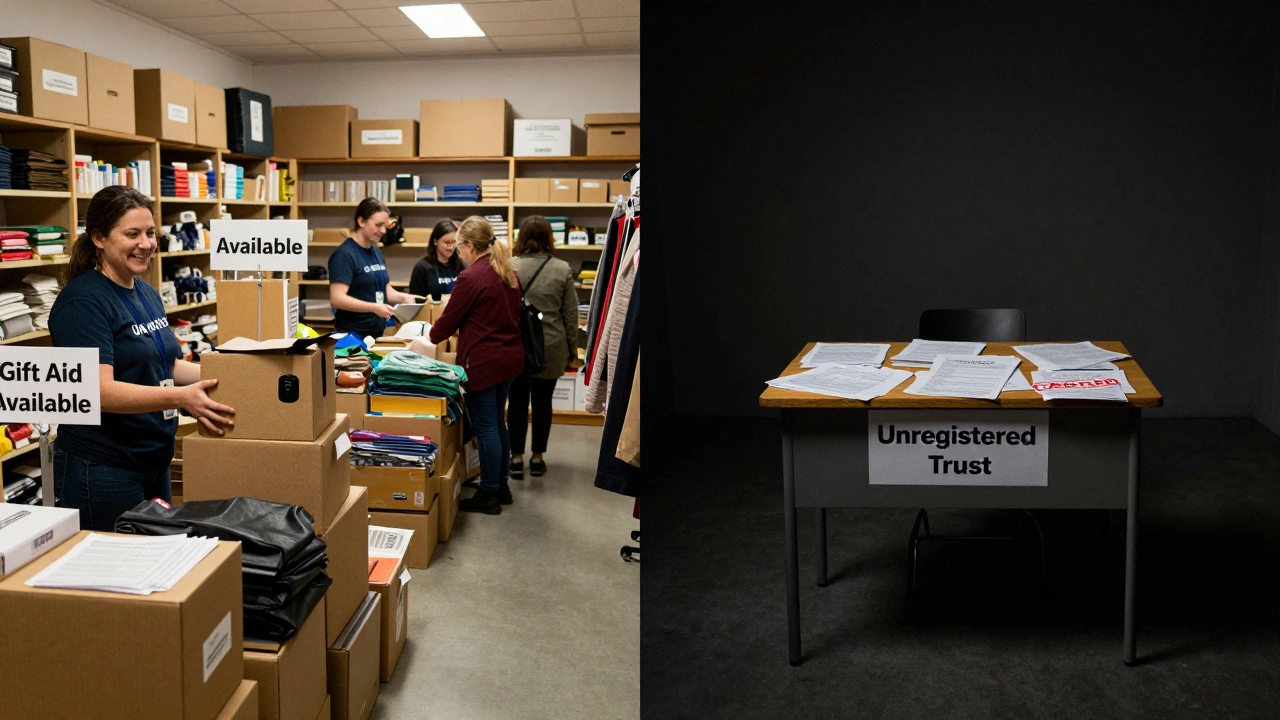
Unregistered trusts? They pay taxes like any other private entity. No exemptions. No exceptions. A trust that’s just called "The Smith Family Foundation" and doesn’t file paperwork? It’ll owe income tax on every pound of interest it earns. That’s a big mistake many make.
What About Trading and Business Income?
Charities aren’t forbidden from running businesses. Many run cafes, shops, or event spaces to raise money. But here’s the catch: if a charitable trust makes money from a trade that’s not directly tied to its mission, it might owe corporation tax.
For example:
- Running a charity shop? Fully exempt. It’s fundraising.
- Operating a hotel for paying guests? That’s a business. If it’s not minor, it’s taxable.
- Selling handmade crafts made by people you support? Exempt, as long as it’s part of your mission.
The rule is simple: if the activity is connected to your charitable purpose, it’s fine. If it’s just a side hustle with no link to your cause? HMRC will come knocking.
Gift Aid: The Hidden Tax Boost
Here’s something most people don’t know: when individuals donate to a registered charitable trust, the trust can claim back tax the donor already paid.
Let’s say someone gives £100. Because they paid income tax, the government adds another £25. The charity gets £125, and the donor doesn’t pay extra. That’s Gift Aid. It’s not a tax cut for the trust-it’s a government top-up. In 2025, UK charities claimed over £1.4 billion in Gift Aid alone.
But again, only if the trust is registered. And only if donors are UK taxpayers. No registration? No Gift Aid. That’s a huge loss.
What Happens If You Break the Rules?
Charitable trusts aren’t free from oversight. If you use money for personal gain-like paying family members too much, or buying luxury cars for trustees-you lose your tax exemption. HMRC can demand back taxes, plus penalties.
One real case from 2024 involved a trust that used £80,000 from donations to fund a trustee’s overseas vacation. The Charity Commission revoked its status. Back taxes? £23,000. Fines? £12,000. The trust had to shut down.
Transparency matters. You need annual reports. You need to show how money is spent. If you can’t prove it goes to your cause, the tax breaks vanish.
Do Charitable Trusts Pay VAT?
VAT is trickier. Charities don’t get a blanket exemption. But they do get special rules:
- Most fundraising events (like charity dinners) are zero-rated for VAT.
- Charitable services (like care homes for the elderly) are exempt from VAT.
- But if you sell goods or services to the public-like tickets to a concert-you might have to charge VAT.
The key is whether the activity is commercial. If it’s a regular business activity, VAT applies. If it’s a donation-based event, it usually doesn’t.
Many trusts use VAT relief schemes like the Charities VAT Relief Scheme to reduce costs on energy, repairs, and equipment. But they need to apply for it separately.
What About Foreign Donations?
If your trust gets money from abroad, it’s still tax-free-if you’re registered. But donors overseas can’t use Gift Aid. The UK government only refunds tax paid by UK taxpayers.
Some countries have their own charity rules. A trust in the US might be tax-exempt under IRS rules, but that doesn’t help in the UK. Each country handles this differently. Always check local laws.
Common Myths About Charitable Trust Taxes
Let’s clear up a few misunderstandings:
- Myth: "All nonprofits are tax-free."
Truth: Only registered charities are. Unregistered = taxable. - Myth: "If I’m not making a profit, I don’t owe taxes."
Truth: It’s not about profit. It’s about purpose and registration. - Myth: "I can use trust money for personal expenses if I’m the founder."
Truth: That’s fraud. HMRC treats it as personal income.
What Should You Do?
If you’re setting up a charitable trust:
- Define your charitable purpose clearly. Use the official categories.
- Register with the right regulator-England/Wales, Scotland, or Northern Ireland.
- Keep detailed records of income and spending.
- Use Gift Aid for UK donations.
- Don’t mix personal and trust finances.
- File annual reports on time.
It’s not complicated. But it does require attention. The tax system is designed to support real charity-not shell organizations.
Final Thought
Charitable trusts don’t pay taxes because they’re not meant to make money for people. They’re meant to serve people. The tax system rewards that. But it also watches closely. If you’re honest, clear, and registered, you’ll keep your tax-free status. If you cut corners? You’ll pay more than you ever saved.
Do all charitable trusts automatically get tax exemptions?
No. Only those registered with the Charity Commission (or equivalent in Scotland or Northern Ireland) qualify. An unregistered trust pays taxes like any private entity-even if it claims to be charitable.
Can a charitable trust make money from a business?
Yes, but only if the business supports its charitable purpose. For example, running a charity shop is fine. Running a standalone hotel for profit isn’t. If the business is unrelated and generates significant income, it may be subject to corporation tax.
Do donors get tax relief when giving to a charitable trust?
Donors themselves don’t get direct tax relief, but the trust can claim Gift Aid. For every £1 donated by a UK taxpayer, the trust gets an extra 25p from the government. That’s a 25% boost without costing the donor anything.
What happens if a charitable trust misuses funds?
If funds are used for personal benefit-like paying trustees excessive salaries or funding private vacations-the trust can lose its tax-exempt status. HMRC can demand back taxes, impose fines, and even dissolve the trust. Trustee misconduct is taken very seriously.
Do charitable trusts pay VAT?
Not always. Many charitable activities are zero-rated or exempt from VAT-like fundraising events or care services. But if a trust sells goods or services commercially (e.g., tickets to a public concert), it may need to charge VAT. Special relief schemes exist for energy and repairs, but you must apply for them.